

A mini spaceship that delivers everywhere in less than an hour

Inversion is an American company founded in early 2021 by Justin Fiaschetti and Austin Briggs, students at Boston University. Fiaschetti had completed internships at SpaceX and Relativity Space, where he worked on propulsion. He left Boston University to co-found Inversion based on a simple idea: “The true economic value of space lies in access to the globe, and we realized we could achieve this through physical cargo. So we founded Inversion to build atmospheric reentry vehicles for this purpose.”
To develop its project, Inversion raised $44 million, taking advantage of the current surge in venture capital firms investing in space.
See: www.facebook.com/watch/?v=1128700851684000
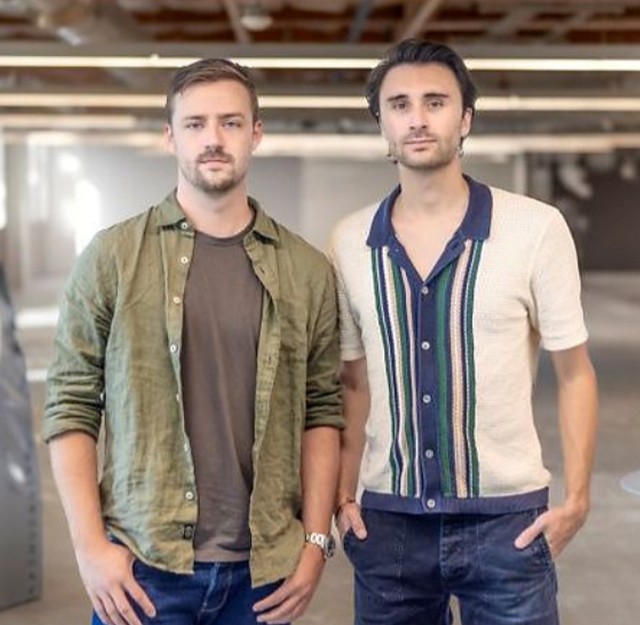 In Los Angeles, on October 1, 2025, the founders of Inversion presented their new autonomous spacecraft, « Arc » (Autonomous, reusable, and low-cost), capable of delivering 225 kg of cargo in less than an hour anywhere in the world.
Developed for less than a million dollars by a team of just 25 people, this reusable capsule, approximately 1.2 m wide and 2.5 m long, is capable of carrying up to 225 kg of equipment.
“Our mission is to preposition the ‘Arc’ capsules in low Earth orbit and maintain them there for up to five years. When they are ready to be deployed, they descend and autonomously land at the desired location,” explained Justin Fiaschetti, co-founder and CEO of the company.
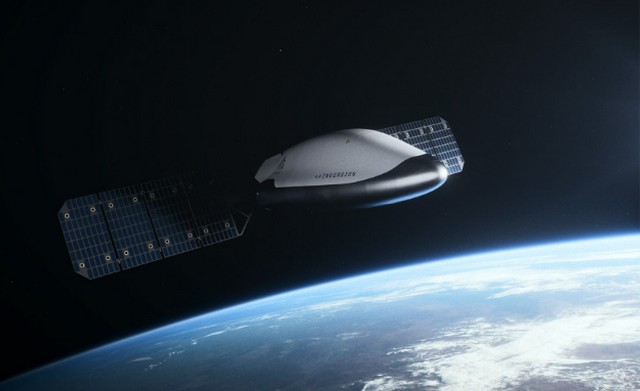 A module can cover an area a thousand kilometers wide, traveling at hypersonic speeds, exceeding Mach 5, to the
approach point. Once on site, « Arc » deploys a parachute and descends to the ground as close as possible to the delivery location.
All this in less than an hour!
Note that the propulsion system uses non-toxic materials, allowing those receiving the equipment to
approach the module directly, without special equipment.
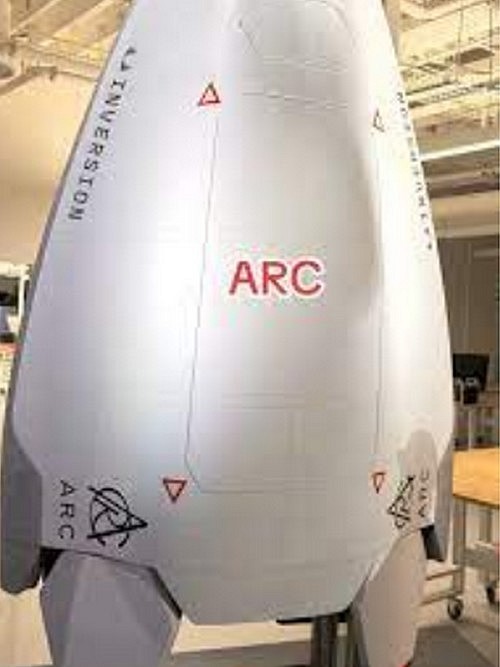 It should also be noted that when in space, the « Arc » module can also capture or deploy elements. It is also capable of
docking with other spacecraft by varying its orbit using thrusters.
For the moment, « Arc » is expected to have a military application and provide the US military with what it might urgently need.
Inversion has begun industrial-scale production of the first modules, and the first « Arc » spacecraft is expected to be available and launched before the end of 2026.
In the longer term, Inversion aims to build hundreds of « Arcs » per year, necessary for the establishment of an operational constellation, which should be operational by 2028, as Fiaschetti emphasizes and reiterates: « The company’s long-term vision is for space to become a new mode of transportation. »
Beyond the military aspect, we can also clearly see all the commercial potential of this Arc module…
In the future, the startup hopes to expand its offerings, for example, by sending everything needed to set up a field hospital in a disaster zone after a natural catastrophe.
So, soon we’ll have a space-based Uber Eats or Amazon?


On the same subject

Strait of Hormuz : How high can it go?
The escalation of the conflict in the Middle East in early March 2026, marked...

Sabre is rethinking its entire model
At the ITB Berlin 2026 international trade fair, technology giant Sabre made history in...

Can Indian AI really compete with the Chinese DeepSeek system ?
India has reached a historic milestone in its quest for technological leadership, finally seeking...

