

75 Space tourism: how Elon Musk made history once again

Despite a slight delay, Starship lifted off at 2:48 PM (French time) on Monday, September 28, from the Starbase facility in Boca Chica, South Texas. The 33 Raptor engines of the heavy booster ignited in unison, slowly tearing the behemoth—standing 120 meters tall and weighing several thousand tonnes at liftoff—away from Earth’s gravity. A routine flight? Not quite!
Following the successful launch of « Starship Flight 14, » I would like to make four observations that further confirm SpaceX’s leadership and the visionary foresight of its boss, Elon Musk.
1st Observation
 For the first time, and after three years of testing and thirteen launches, Starship successfully reached Earth orbit. This « first » truly changes everything for SpaceX.
The company aimed to fly the rocket for as long as possible, with the specific goal of maintaining orbit. Mission accomplished: the Starship rocket has moved beyond the suborbital flight stage! This bodes well for Elon Musk, whose ambition is to use Starship to reach the Moon and Mars as quickly as possible. 2nd point
 The Starlink V3 satellites deployed during this fourteenth Starship flight are significantly larger than their predecessors (V2) and, crucially, are capable of delivering download speeds of up to 1 terabit per second—roughly ten times the capacity announced for a V2 satellite.
The craft also feature 2,048 radio beams, compared to just a few hundred in the previous generation. In other words, the satellite can now divide its coverage area into a multitude of zones and concentrate its capacity where user density is highest.
Finally, another new feature is that these V3 units are equipped with six 400 Gbit/s laser links. This allows the satellites to route data directly between one another without relaying it via Earth.
With this launch on September 28, Starlink has thus taken a giant leap forward in high-speed satellite broadband. 3rd point
As SpaceX engineers have noted, this performance represents roughly ten times the capacity of a standard Starlink V2 satellite launch on the Falcon 9.
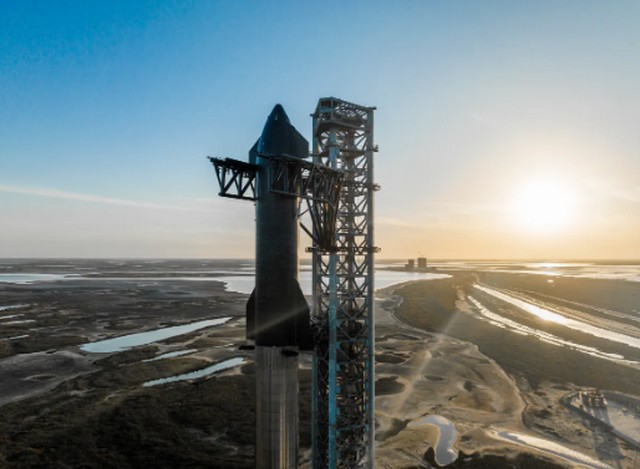 This deployment of 26 Starlink V3 satellites illustrates just how indispensable Starship has become to the future of Starlink, given that these next-generation satellites are simply too large and heavy to be launched in significant numbers by the Falcon 9 rocket.
4th point
The success of « Starship Flight 14 » confirms and reinforces what has been known for several weeks: the discontinuation of commercial Falcon 9 flights starting in 2028—a move that could leave dozens of European and international satellite developers grounded.
Indeed, only a few missions for NASA—specifically resupply and crew transport to the International Space Station—will remain active through 2030.
A new headache in store for the European space sector!


On the same subject

The African continent on the path to space tourism
On the sidelines of the WSIS Forum 2026, held from July 6 to 10...

Amadeus partners with Anthropic for tool integration
As part of a major strategic partnership, travel technology giant Amadeus is integrating with...

Why must we now fear for existing dams ?
The rapid accumulation of silt, soil, and rock at the bottom of artificial reservoirs...



